
Latest Articles
Shipping Container Offices: Why Businesses Are Ditching Traditional Construction in 2026
Dec
Table of Contents
- The Numbers Behind the Surge
- Why Businesses Are Making the Switch
- Who’s Actually Buying Container Offices
- The Construction Industry’s Unexpected Driver
- What to Consider Before You Buy
Traditional office construction has never been cheap or fast, and in 2026 it’s neither getting cheaper nor faster. That gap is exactly why shipping container offices have moved from a niche construction-site solution to a mainstream workspace choice across a widening range of industries.
The Numbers Behind the Shipping Container Office Surge
The global mobile container office market was valued at roughly $3.5 billion in 2025 and is projected to keep climbing steadily through the next decade, driven by demand for portable workspace solutions across construction, real estate, healthcare, and retail. That growth sits inside a much larger modular construction market, which analysts expect to reach well over $150 billion — a scale that reflects just how mainstream prefabricated and modular building has become as an alternative to ground-up construction.
Why Businesses Are Making the Switch
Four advantages keep showing up in why companies choose a shipping container office over traditional construction:
Speed. A container office can often be delivered and operational within days or weeks, compared to months for a conventional build-out. For businesses that need workspace now — not after a permitting and construction cycle — that difference alone can be decisive.
Mobility. Unlike a permanent structure, a container office can be relocated between job sites or properties as a project or business need shifts, making it a genuinely reusable asset rather than a sunk cost tied to one location.
Cost efficiency. For small-to-medium footprint workspace needs, container offices are typically cheaper to build and maintain than traditional construction, with meaningful savings on both materials and labor.
Modular expansion. Businesses can add capacity by combining or stacking additional units as they grow, rather than committing to a fixed building size upfront.
Who’s Actually Buying Container Offices
The buyer base has broadened well past the construction trailers most people picture:
- Construction and real estate development — on-site project offices positioned close to active work
- Healthcare — mobile clinics and temporary medical facilities, particularly useful for expanding access in underserved areas
- Retail — pop-up shops and temporary storefronts that need a professional look without a long-term lease commitment
- Education — temporary or overflow classroom and administrative space
- Agriculture — on-site offices for farm and ranch operations that need a real workspace without permanent construction
- Tech and creative businesses — standalone studio or satellite office space, often chosen specifically for the industrial aesthetic
The Construction Industry’s Unexpected Driver: Office-to-Residential Conversions
One of the more interesting demand drivers right now is happening in major cities where older office buildings are being converted into apartments, hotels, and mixed-use developments. These conversion projects still need on-site project management space during construction — and modular container offices have become a preferred solution because they free up interior building space for the actual conversion work instead of using it for a temporary site office. Associated Builders and Contractors, the national construction industry trade association, has tracked ongoing labor shortages across the industry — and with skilled labor in short supply, anything that reduces onsite coordination friction and speeds up delivery timelines has real value, which is exactly what container offices deliver.
What to Consider Before You Buy
- Temporary vs. semi-permanent use case. A short-term job-site office has different requirements (and a lower price point) than a business office intended to operate for years — be clear about which one you’re buying before comparing quotes.
- Climate control and insulation needs. A container office used year-round in extreme climates needs proper insulation and HVAC planning from the start, not as an afterthought.
- Electrical and connectivity requirements. Confirm power capacity and any networking/connectivity needs match your actual business use before finalizing your order.
- Local permitting. Even semi-permanent container offices are often subject to local zoning and building code review — check requirements before committing to a site.
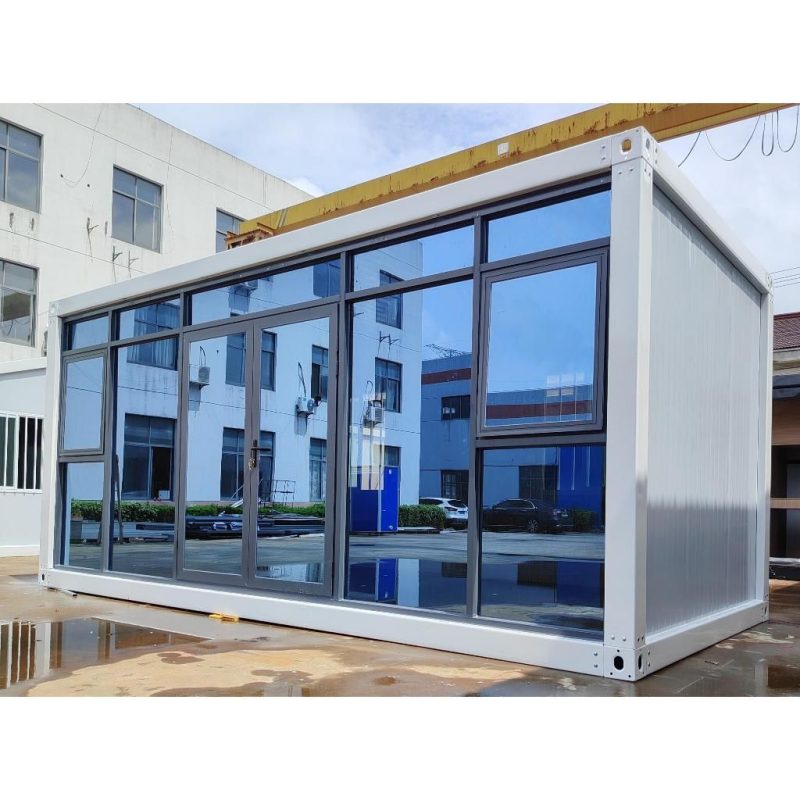
Our 20ft container office conversion is built specifically for fast-deployment business use, with insulated cladding and window options ready to configure for your team. Browse our full container modification services for custom electrical, HVAC, or layout requirements, or compare base container sizes on our container size guide if you’re planning a custom build.
Sources: Intel Market Research mobile container office market outlook; Interport modular office conversion analysis; Storage on Wheels container office demand report.
